What is the PVG Scheme?
The Protecting Vulnerable Groups (PVG) scheme is managed by Disclosure Scotland. It helps ensure people who are unsuitable to work with children and protected adults cannot do regulated roles with these groups.
On this page, you will find more information about the scheme, how it affects youth work organisations, staff and volunteers and how you can access the scheme through the Youth Scotland membership package.
What Does the PVG Scheme Cover?
It will exclude people who are known to be unsuitable, on the basis of past behaviour, from working with children and/or protected adults and detect those who become unsuitable while in the workplace.
The PVG Scheme is managed and delivered by Disclosure Scotland and provides the following services:
- processing applications for disclosure checks
- running the Protecting Vulnerable Groups (PVG) scheme for people who work with children or protected adults
- keeping a list of people barred from working with children and protected adults
The scheme is now compulsory for anyone working or volunteering in a Regulated Role and each Organisation must check new workers/volunteers before they take up their role. Organisations must note, however, that it is an offence to ask an individual to join the PVG Scheme if they are not carrying out, or will not carry out, regulated work.
What is Regulated Work?
The PVG Scheme Guidance suggests that three questions should be asked to establish if an individual is doing regulated work:
- Is your role on the list of regulated roles?
- Are you doing an activity mentioned in Schedules 2 and 3 of the PVG Act?
- Do you have contact with children, protected adults or both?
For most individuals carrying out ‘normal’ youth work roles it is likely they will meet the criteria for PVG Scheme membership, this includes volunteers, for example anyone who is on a rota for a youth group. The activities covered by ‘regulated work’ include:
- Caring for children
- Teaching, instructing, training or supervising children
- Being in sole charge of children
- Unsupervised contact with children under arrangements made by a responsible person
- Providing advice or guidance to a child or to particular children which relates to physical or emotional well-being, education or training
- Trustees etc.
Organisations need to decide which posts involve these activities and ensure that those carrying them out are PVG Scheme members. Disclosure Scotland maintain a list of Regulated Roles and also has an online tool to check if a role needs PVG scheme membership. Further guidance on Regulated Roles is published by Disclosure Scotland and should be referred to when deciding if a role is a Regulated Role or not.
Additionally, Disclosure Scotland has provided a flowchart guide to support this decision.
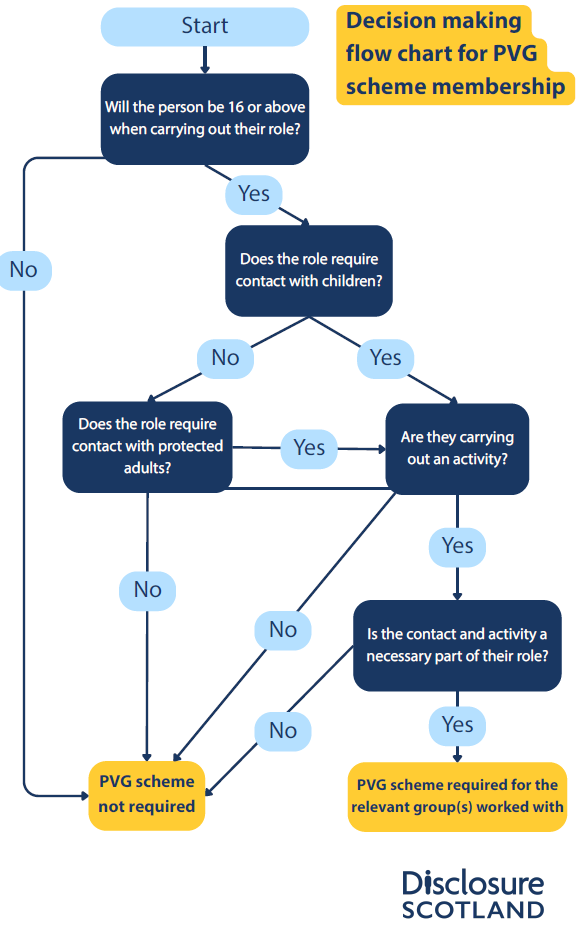
Decision-making flowchart from Disclosure Scotland.
PVG Scheme Membership
The PVG Scheme is a membership scheme, which means that everyone in the Scheme will have a unique membership number and an ‘account’. Individuals are responsible for keeping the Scheme up to date with their current information, such as address, name and organisations where they carry out regulated work. This will allow the Scheme to maintain up to date records and provide information quickly when it is requested.
As an individual: you will set up an online account with Disclosure Scotland when you apply to the Scheme for the first time. It’s very important that you keep your log in details in a safe place as you will need it in the future.
As a group: when you are recruiting a volunteer that is already a PVG Scheme member you must still apply for a PVG for them. This registers your Organisation’s interest in them and ensures that you are kept informed of any changes to their record.
You should ensure that your organisation’s Secure Handling, Retention and destruction of PVG Scheme Information Policy details who in your club or group is permitted to access confidential conviction information.
Membership of the PVG scheme lasts for five years from the date of joining and it is the responsibility of the worker/volunteer to renew their membership. The PVG scheme membership renewal process is separate from applying for a PVG. Renewals will be completed through the individual’s online account, with an offline option available for anyone who cannot use the digital service. More information about the 5-year membership scheme is available from Disclosure Scotland
Access the PVG Scheme via Youth Scotland
Youth Scotland acts as an Umbrella Body, which means that if you are an affiliated group you can access the PVG Scheme through us, for both paid and unpaid posts. In order to do this you will need to appoint a Named Contact in your group that is willing to take on the responsibility of receiving the information on Scheme Records and abide by the Code of Practice.
Youth Scotland provides a package of support, including template policies and forms to groups that access the PVG Scheme through Youth Scotland.
If you would like to access the PVG Scheme through Youth Scotland please contact us on: office@youthscotland.org.uk
Costs of the PVG Scheme
Volunteers
For volunteers in qualifying organisations (i.e. the voluntary sector) there is no direct cost for Scheme Records and Updates. If you register with Disclosure Scotland there is an annual fee to be a registered organisation. Volunteer Scotland provides access to free checks for voluntary sector volunteers.
Youth Scotland members can also access the PVG Scheme as part of their membership package.
Paid staff
An application to join the PVG Scheme is £59 for paid staff, or volunteers that are not working in the voluntary sector (e.g. volunteers in schools).
For existing members of the PVG scheme, the application fee is £18.
Recruitment of Ex-Offenders
Sample Policy for Recruitment of Ex-Offenders
The Rehabilitation of Offenders Act 1974 puts in place legislation regarding people that have been convicted of a criminal offence and have not re-offended since. Under certain circumstances, ex-offenders can ‘wipe the slate clean’ of their criminal record once a period of time has lapsed from the date of conviction, if the custodial sentence was less than 2.5 years. Provided they have not been re-convicted for another offence, their conviction is said to become ‘spent’ and for the purpose of employment it can be treated as though it never existed. This means that if the ex-offender is asked on an application form, or at an interview, if they have a criminal record they are entitled to answer ‘no’. It is illegal for an employer to discriminate against the ex-offender on grounds of their spent conviction.
However, some types of employment are exempted from the Rehabilitation of Offenders Act. One of the exemptions is work that involves contact with young people. Therefore, when applying for a post that involves contact with young people, the ex-offenders have to disclose all convictions, spent or otherwise.
The purpose of a Recruitment of Ex-Offenders Policy is to ensure consistent and fair practices are implemented for the recruitment of staff and volunteers who have a criminal record. Having a criminal record does not automatically make a person unsuitable to work with young people. The Policy should state the sort of details that the organisation needs to consider:
- Whether the conviction or other matter(s) revealed is relevant to the position in question.
- The seriousness of any offence revealed.
- The length of the time since the offence or other matter(s) occurred.
- Whether the applicant has a pattern of offending behaviour or other relevant matters.
- Whether the applicant’s circumstances have changed since the offending behaviour or the other relevant matters.
The use of a Self-Declaration Form at the interview stage of volunteer recruitment will allow the applicant to disclose and discuss conviction information, its context and any issues connected with it. This can then be compared to the information contained on the Scheme Record.
Handling PVG Scheme Information
Organisations that receive information about volunteers through the PVG Scheme are required to comply with the Code of Practice. The Code of Practice is published by the Scottish Ministers under section 122 of Part V of the Police Act 1997 and places a responsibility on organisations to handle, use, retain and destroy the information in particular ways. Registering with an Umbrella Body (such as Youth Scotland) can assist organisations to meet the requirements of the Code, as the Umbrella Body is responsible for the storage and disposal of the information.
However, organisations that receive disclosure information, even if from an Umbrella Body, still have a number of obligations. These are to do with the use of the information once it is passed to the organisation. Confidentiality must be maintained at all times, and the post holders that are allowed to receive the information ‘in the course of their duties’ should be detailed in the organisations ‘Secure handling, retention and destruction of disclosure information Policy’.